Implementing an Employee Recognition Program in Canadian Retail: A Practical Guide [Article 4/5]
April 14, 2026, In Management & Organizational Performance
In the first three articles of this series, you discovered the six HR challenges facing Canadian retail, how recognition transforms them into opportunities, and the six pillars of an effective program. Now, the crucial question: how do you move from theory to practice? In this article, we provide you with a clear roadmap, step by step, to implement an employee recognition program in your retail organization, regardless of your size.
Missed the previous articles?
Step 1: Diagnose Your Current Situation

Objective: Understand where you are before deciding where you want to go.
Before investing time and money in an employee recognition program, you must first assess your current situation. Without this diagnosis, you risk building on weak foundations or solving the wrong problems.
Concrete Actions:
1. Audit Your Current Recognition Practices
Ask yourself these questions:
- Do we currently have formal recognition programs? Which ones?
- How do we celebrate years of service? Retirements? Exceptional performance?
- How much do we invest annually in recognition?
2. Collect Quantitative Data
Measure what already exists:
- Current turnover rate (overall and by site)
- Employee engagement scores
- Participation rates in existing programs
- Employee replacement costs (recruitment, training, lost productivity)
- Number of employees recognized in the last 12 months
3. Survey Your Employees and Managers
Ask simple questions:
- To employees: “Do you feel recognized for your work? How often? By whom? What form of recognition do you prefer?”
- To managers: “Do you regularly recognize your employees? What are the obstacles? What tools do you need?”
Use a short survey (5–7 questions maximum) to maximize response rate.
4. Identify Your Biggest HR Challenges
Once you have all the data, both qualitative and quantitative, you can identify your priorities for the year. These may be related to the six challenges presented in the first article of the series or focus on other aspects specific to your organization. Each company is unique, which makes this preliminary analysis work essential before taking action.
Step 1 Deliverables:
- Audit report of current practices (2–3 pages)
- Baseline data to measure future progress
- Employee/manager survey results
- Prioritized list of challenges to address
Approximate duration: 2–4 weeks
Step 2: Define Your Objectives and Vision

Objective: Clarify what you want to accomplish with recognition and how you will measure success.
A recognition program without clear objectives is like a store without a business strategy: you risk investing a lot of effort without tangible results.
Concrete Actions:
1. Establish SMART Objectives
Your objectives must be Specific, Measurable, Achievable, Realistic, and Time-bound.
Examples of SMART objectives:
- Reduce voluntary turnover rate from 25% to 18% within 18 months
- Achieve 80% participation in the service anniversary program within 12 months
- Increase employee engagement score from 65% to 75% within 24 months
- Ensure 100% of employees receive at least one recognition per month within 6 months
2. Define Your Recognition Vision
Beyond the numbers, what experience do you want to create?
Complete this sentence: “In our organization, recognition means that…”
Example: “In our organization, recognition means that every employee, regardless of their role or location, feels valued daily for their contributions, understands how their work aligns with our values, and has access to growth opportunities.”
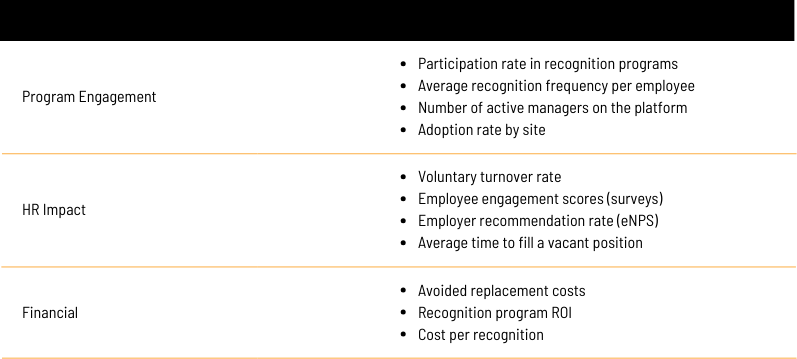
3. Identify Your Success Indicators (KPIs)
Choose 5–7 indicators you’ll track quarterly:
4. Obtain Leadership Approval
Prepare a one-page business case with:
- Current situation (Step 1 diagnosis)
- Target objectives
- Required investment (estimated budget)
- Expected ROI (use data from Article 2:31% turnover reduction, etc.)
- Implementation plan (overview)
Step 2 Deliverables:
- SMART objectives document (1 page)
- Vision statement
- KPI dashboard (with targets and timelines)
- Leadership-approved business case
Approximate duration: 2–3 weeks
using our free guide to convince decision-maker
Step 3: Design Your Program

Objective: Concretely define what your recognition program will look like.
This is where you take the six pillars from Article 3 and transform them into a concrete program for your organization.
Concrete Actions:
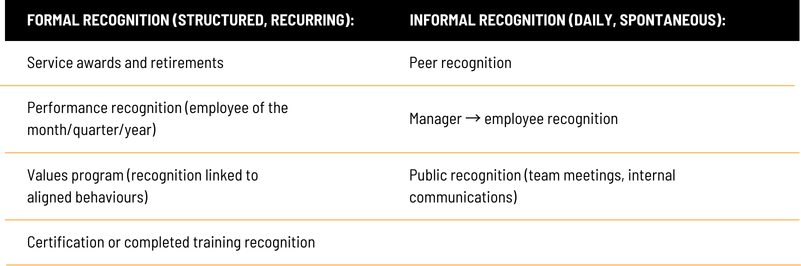
1. Decide on the Types of Recognition to Offer
Based on your objectives and budget, choose from:
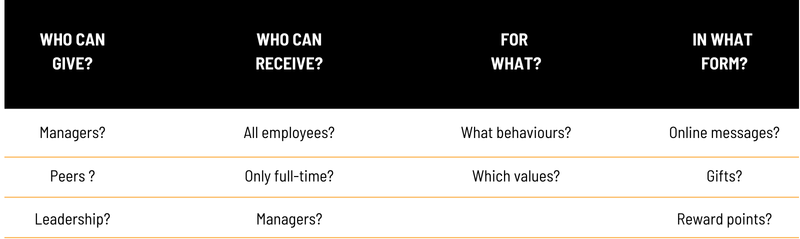
2. Establish the Rules of the Game
For each type of recognition, define:
3. Define Your Budget
Calculate your annual budget based on:
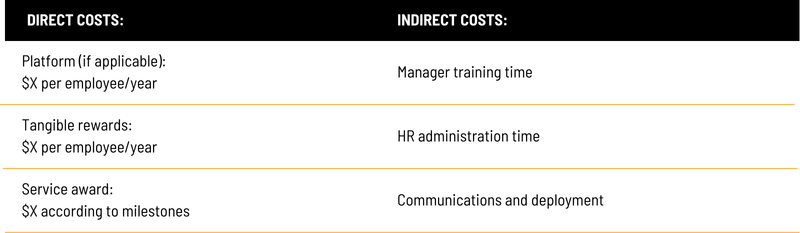
Budget reference: Organizations generally invest between $50 and $200 per employee per year in recognition, depending on the program’s maturity level. Don’t forget to consider the Canadian tax law in your budgeting.
4. Choose Your Recognition Partner and Tools (if applicable)
If you opt for an employee recognition platform, it’s important to choose the technological tool and the partner who will support you in implementing and evolving the program.
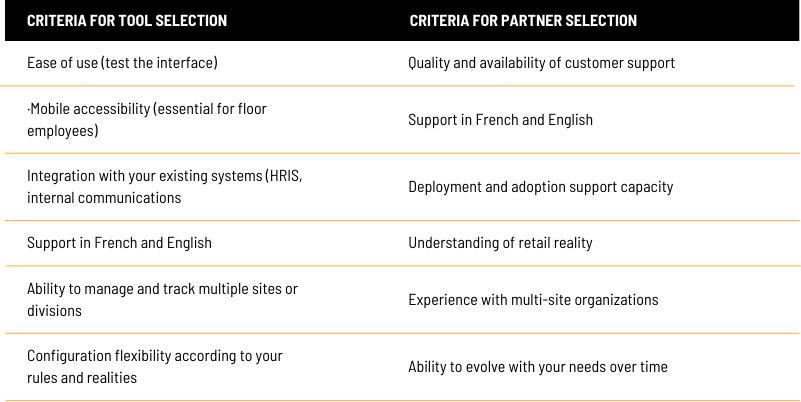
<span style=”color: #ffffff;”>with our free checklist</span>
5. Align with Your Organizational Values
Ensure your program concretely reinforces your values:
- If you have 4–5 company values, integrate them directly into recognition criteria
- Create badges or recognition categories linked to each value
- Train managers to identify and recognize behaviours that embody these values
Step 3 Deliverables:
- Program design document (5–10 pages), including:
- Types of recognition offered
- Detailed rules and criteria
- Detailed budget
- Technology and partner choice (if applicable)
- Documented recognition processes (workflows)
Approximate duration: 5–8 weeks depending on organization size
Step 4: Prepare for Deployment

Objective: Set up infrastructure and prepare stakeholders before launch.
A successful deployment isn’t improvised. This step is crucial to avoid technical problems and organizational confusion.
Concrete Actions:
1. Configure Your Recognition Platform
If you’re using a platform:
- Import your employee data (names, roles, sites, managers)
- Configure recognition programs according to your rules
- Customize the interface to your brand
- Configure notifications and automatic reminders
- Rigorously test all scenarios (giving/receiving recognition, exchanging points, etc.)
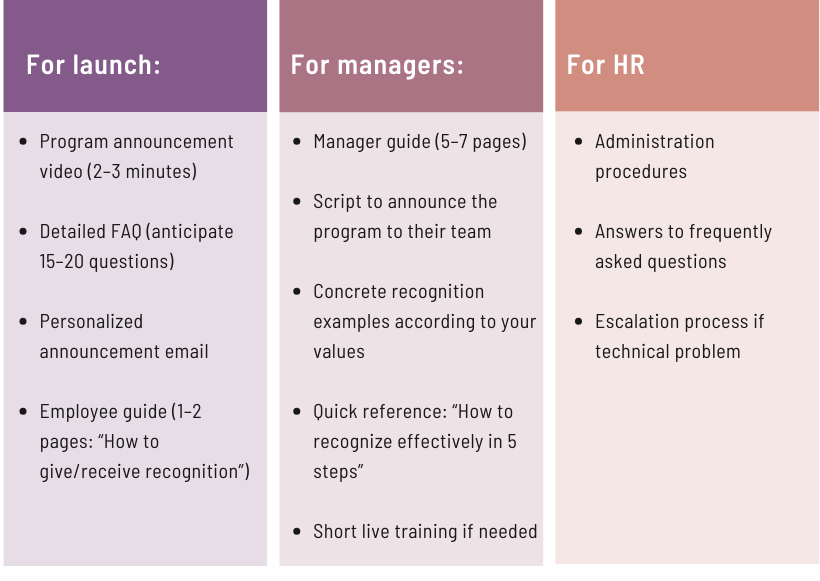
2. Create Your Communication Tools
Develop a complete kit including:
3. Train Your Managers
Managers are your #1 success lever. Invest in their training.
Recommended format: A 45-minute session to raise awareness of the importance of recognition, providing concrete examples adapted to their daily routine.
To go further: Offer online training to help them develop the habit of recognition.
Tip: Train managers 1–2 weeks before the general launch. They must be comfortable before training their teams.
4. Identify Your Ambassadors
Recruit 5–10 “recognition champions” across different sites:
- Enthusiastic managers with influence
- Employees respected by their peers
Their role:
- Actively promote the program
- Answer colleagues’ questions
- Provide feedback to the HR team on adoption
- Be the first to use the program (modelling)
Tip: For peer-to-peer recognition programs, designating an ambassador within the HR team is useful for designing and facilitating incentive campaigns to encourage platform adoption and use.
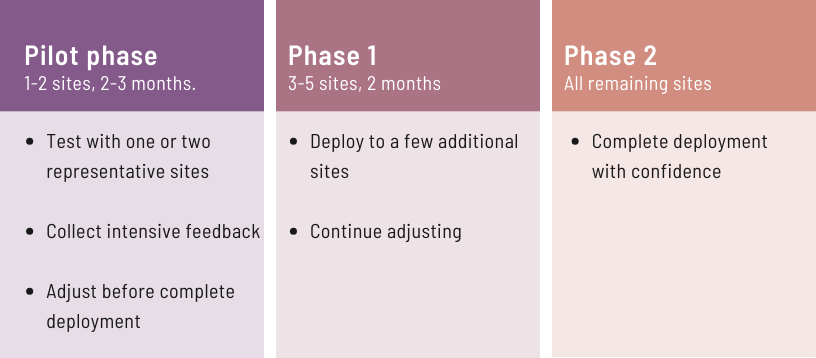
5. Plan Your Phased Deployment (if applicable)
Step 4 Deliverables:
- Configured and tested platform
- Complete communication kit
- Trained managers (100% attendance)
- Identified and briefed ambassadors
- Detailed deployment plan with dates
Approximate duration: 3–4 weeks
Step 5: Launch and Facilitate the Employee Recognition Program

Objective: Deploy the program with impact and maintain engagement in the critical first months.
The first 90 days after launch often determine the program’s success or failure. Facilitation is essential.
Concrete Actions:
1. Organize a Memorable Launch
Launch day should create momentum and excitement. Once the core impact elements are in place, such as:
- A compelling and memorable program name (e.g., “Univers” at Groupe Amiel)
- A strong, distinctive visual identity (logo, colors)
- Visible leadership commitment (CEO video, leaders recognizing first)
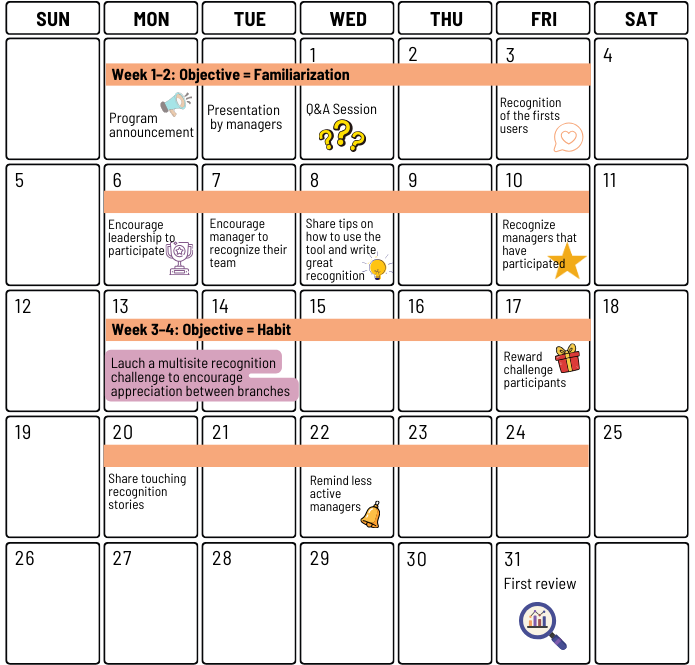
design a launch calendar that sustains engagement throughout the first 30 days.
Example of a Peer-to-Peer Recognition Program Launch Calendar
2. Maintain Momentum (Months 2–6)
Monthly facilitation tactics:
To ensure continuity and engagement around your program, it’s essential to implement a structured annual calendar including recognition campaigns and incentive actions distributed throughout the year. This calendar helps maintain employee interest, reinforce desired behaviours, and durably anchor recognition in organizational culture.
Examples of thematic campaigns:
- Month 2: “Collaboration month”: recognition of collaborative behaviours and mutual support between teams
- Month 3: “Customer service month”: recognition of “wow” moments with customers
- Month 4: Multi-site contest: recognition of colleagues working in another branch to foster inter-site connections
Regular communications:
Continuous and structured communications are essential to maintain program visibility, highlight good practices, and encourage participation. They demonstrate recognition’s concrete impact, strengthen team buy-in, and support long-term engagement.
- Monthly newsletter: key program statistics, inspiring stories, most active employees and teams in recognition
- Highlighting managers who practise recognition most to encourage managerial exemplarity
- Sharing employee testimonials highlighting recognition’s positive impact on their motivation and daily life
Continuous adjustments:
To maintain program effectiveness, it’s essential to gather employee feedback and continuously adjust the program according to their needs:
- Quick survey at month 3: “What do you think of the program? How can we improve it?”
- Adjust based on feedback
3. Manage Common Challenges as Priority
After launching the recognition program, several challenges may appear. Some will be site specific, other more general. It’s important to prioritize resolving those affecting the largest number of employees to maximize impact and ensure program continuity.
Common challenges and solutions:
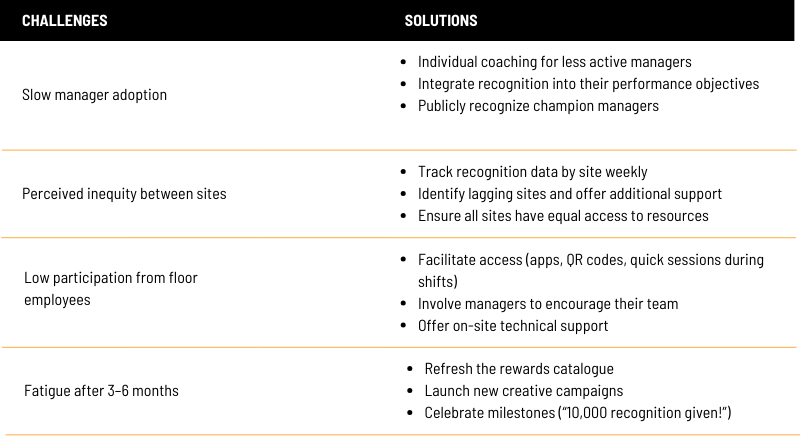
Step 5 Deliverables:
- Officially launched program
- 6-month facilitation plan executed
- Monthly adoption and engagement report
- List of adjustments made
Approximate duration: Ongoing (the first 6 months are critical)
Step 6: Measure, Adjust, and Sustain

Objective: Transform the program from “new” to “anchored in culture.”
A recognition program is never “finished.” This step ensures it evolves and continuously improves.
Concrete Actions:
1. Measure ROI and Impact
At 6 months, 12 months, and annually:
Compare your current KPIs vs. baseline (Step 1). Share these result with leadership and celebrate the wins.
2. Collect Qualitative Feedback
Beyond numbers, listen to voices:
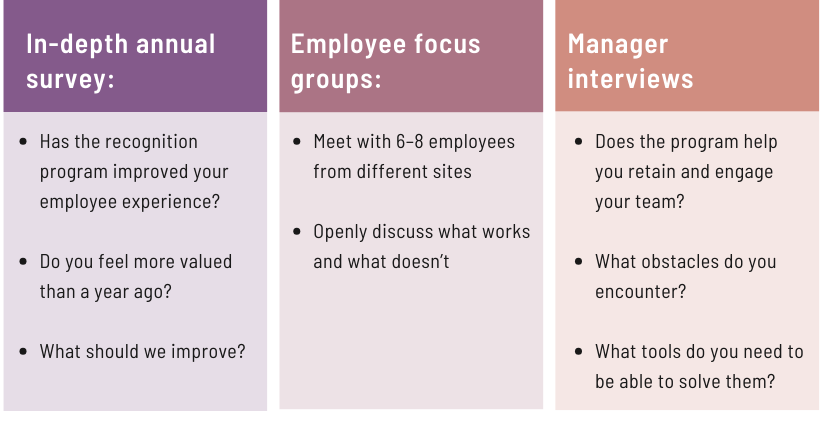
3. Adjust and Improve
Based on data and feedback, identify improvement opportunities and define tactics to deploy for the coming year. This also helps plan the next phase aimed at anchoring recognition in organizational culture.
4. Anchor in Organizational Culture
Here are some ideas to sustain recognition:
Integrate into HR processes:
- Onboarding: Present the program on day one and award recognition in the first week
- Manager training: Mandatory recognition module
- Annual evaluations: Include “ability to recognize” as a performance criterion
Integrate into manager practices:
- Offer practical tools: message templates, quick recognition ideas, follow-up checklists
- Encourage regular recognition: integrate it into team meetings, individual check-ins, and project reviews
- Measure and value: share statistics and celebrate the most active managers to create exemplarity
Communicate successes:
- Annual reports: Include recognition stats
- General assemblies: Celebrate highlights
- Recruitment: Use the program as an employer brand argument
5. Plan Continuous Evolution
Create a recurring annual calendar:
- January: Review years objectives and KPIs
- Quarterly: Adoption report and adjustments
- June: Mid-year survey
- October: Year-end campaign planning
- December: Complete annual review and celebration
Step 6 Deliverables:
- Complete ROI report (annual)
- Continuous improvement plan
- Recognition anchored in HR processes
- Next year’s calendar
Approximate duration: Ongoing, quarterly and annual reviews
What Now? Moving from Reading to Action
You now have
- A complete 6-step guide to implement recognition
- Concrete actions for each step
- Clear deliverables and realistic timelines
But one question remains: What differentiates organizations that succeed from those that fail in their recognition program?
This is exactly what we’ll explore in the final article of this series. We’ll reveal the 10 fatal mistakes to absolutely avoid, and how the highest-performing organizations circumvent them.
Want personalized support for your implementation? Contact us to discuss your specific situation and get a customized plan.

The Author

Alexandra Thibaudeau
Marketing Project Manager
Passionate about the world of communications and marketing, Alexandra joined the Altrum team in 2023 with nearly 8 years of solid experience in the field. She implements innovative strategies and creates customized tools to help companies inspire and celebrate their employees.